How Does Home Insulation Work?
9 min read
Every house is constantly leaking heat. In winter, warmth generated indoors drifts toward the colder outdoors; in summer, the direction reverses and heat pushes its way in. Home insulation is the material that slows this exchange down. It does not create warmth or coolness of its own. Instead, it acts as a barrier that makes heat travel more slowly through walls, roofs and floors, so the temperature you have paid to reach lasts longer before it slips away.
That single job has an outsized effect on comfort and cost. A well-insulated home holds a steady temperature with less help from a furnace, boiler, air conditioner or heat pump, which means the equipment runs less often and uses less energy. Understanding how insulation actually achieves this, and how its performance is measured, makes it easier to judge what is worth installing and where.
This explainer walks through what insulation does, the physics of heat movement it is fighting, the meaning of the R-value printed on every product, the common materials on the market, and the parts of a house that leak the most.
What insulation actually does
Heat always moves from warmer areas to cooler ones. It never does the reverse on its own. The purpose of home insulation is not to stop that movement entirely, which is physically impossible, but to slow it to a crawl. Think of it less like a wall and more like a thick coat: the warmth is still escaping, just far more gradually.
Most insulating materials work by trapping tiny, still pockets of air. Air is a poor conductor of heat, so as long as it stays put, it resists the flow of thermal energy. The fibers, foams and beads used in insulation exist mainly to hold that air in place and stop it from circulating. When air is allowed to move freely, it carries heat with it, which is why a drafty gap undermines even thick insulation around it.
The basics of heat transfer
To see why insulation is built the way it is, it helps to know the three ways heat travels. Insulation is designed to interrupt all of them, though it tackles some more directly than others.
- Conduction is heat moving through a solid material, passing from one molecule to the next. A metal spoon left in a hot drink warms along its whole length by conduction. Insulation fights this by using materials that conduct poorly and by breaking up the solid paths heat can follow.
- Convection is heat carried by moving air or liquid. Warm air rises, cool air sinks, and the resulting circulation shifts heat around a room and out through gaps. Trapping air in small cells stops it from circulating and carrying heat away.
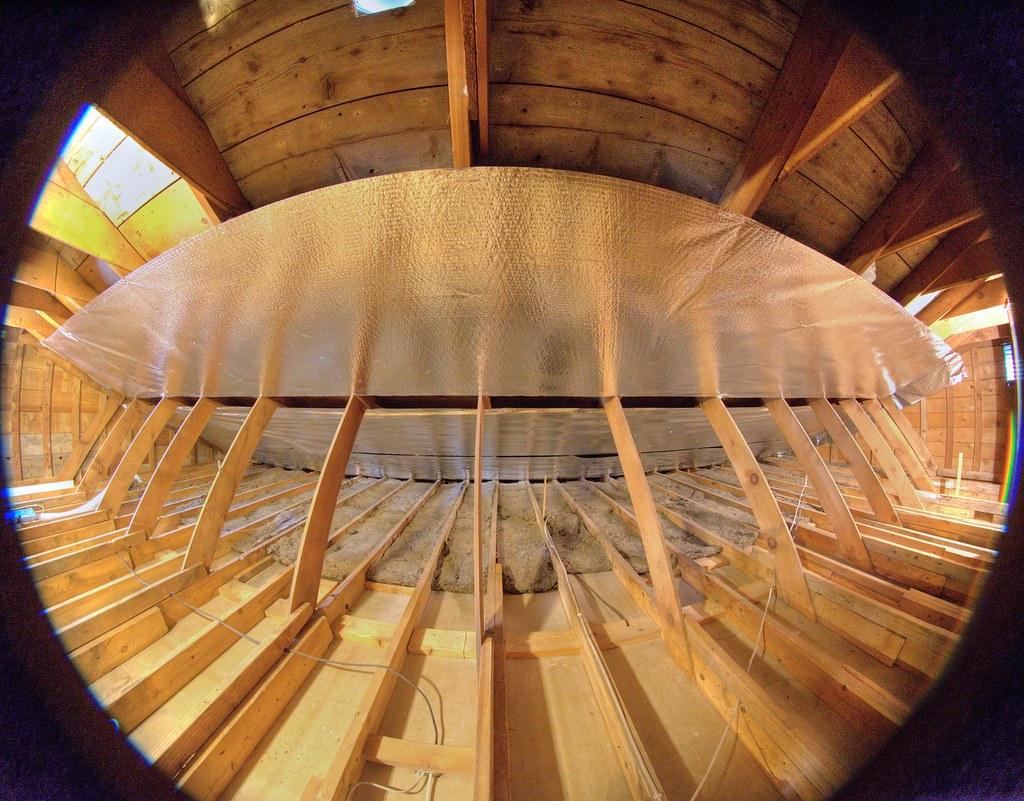
- Radiation is heat traveling as infrared energy across open space, the way you feel warmth from a fire without touching it. Reflective foil layers and certain coatings are designed to bounce radiant heat back rather than absorb it.
Ordinary bulk insulation such as fiberglass or mineral wool mainly targets conduction and convection by holding still air in place. Reflective products, sometimes called radiant barriers, are added where radiant heat is the bigger problem, such as a roof space that bakes under summer sun.
What R-value means
The single most useful number on any insulation product is its R-value. R-value measures thermal resistance: how strongly a material resists the flow of heat through it. The higher the R-value, the slower heat passes, and the better the material insulates. It is the standard way to compare products of different thicknesses and materials on equal terms.
A few principles make R-value easier to read. Thicker layers of the same material have higher R-values, because heat has further to travel. Denser or better-designed materials can reach a given R-value in less space. And R-values are additive: if you lay a second layer of insulation over an existing one, their R-values roughly add together, which is why topping up a thin attic layer can make a noticeable difference.
Two cautions matter. First, R-value assumes the material is installed properly, without gaps, compression or moisture, all of which reduce real-world performance. Compressing a batt to squeeze it into a tight space lowers its effective R-value. Second, the R-value that makes sense for a home depends heavily on climate. A house in a cold region benefits from far higher levels of home insulation than one in a mild climate, and recommended targets differ accordingly. In some regions the same idea is expressed as a U-value or U-factor, which is essentially the inverse: a lower U-value means better insulation.
Common types of insulation
Insulation comes in several formats, each suited to different parts of a house and different budgets. The main categories include:
- Batts and rolls are pre-cut or rolled blankets, commonly made of fiberglass or mineral wool, sized to fit between the standard spacing of wall studs, floor joists and roof rafters. They are widely used because they are relatively cheap and straightforward to fit in open, regularly spaced cavities.
- Loose-fill or blown-in insulation is made of loose fibers or pellets, often cellulose, fiberglass or mineral wool, blown into place with a machine. It excels at filling attics and awkward, irregular spaces where a rigid batt would leave gaps.
- Rigid foam boards are stiff panels that deliver a high R-value in a thin profile. They are often used on exterior walls, foundations and roofs, and where space is limited.
- Spray foam is applied as a liquid that expands and hardens, sealing gaps as it fills them. It can both insulate and act as an air barrier, though it is typically more expensive and usually installed by professionals.
- Reflective and radiant barriers use foil-faced materials to reflect radiant heat, and are most useful in hot climates or roof spaces exposed to strong sun.
No single type is best for every situation. The right choice depends on which part of the building is being treated, whether the cavity is open or already enclosed, the local climate, and how much air sealing is needed alongside the insulation itself.
Where homes lose the most heat
Heat does not escape evenly across a building. Because warm air rises, the roof and attic are usually the biggest source of loss in a heated home, which is why topping up attic insulation is often the first and most cost-effective step. Walls come next, given their large surface area, followed by floors, especially those above unheated spaces such as a crawl space or garage.
Gaps and cracks matter as much as the insulation itself. Air leaking around windows, doors, loft hatches, pipes and electrical fittings lets heat bypass the insulation entirely by convection. This is why air sealing and insulation are often treated together: sealing the leaks stops the drafts, and the insulation slows the heat that still tries to conduct through solid surfaces. Windows themselves are relatively poor insulators compared with a well-insulated wall, which is part of why double or triple glazing exists.
The reason this all translates into lower bills is straightforward. Heating and cooling are among the largest energy uses in a typical home. When insulation and air sealing slow the rate at which conditioned air is lost, the heating or cooling system reaches the target temperature and then rests for longer before it needs to run again. Less run time means less energy consumed for the same level of comfort.
How to think about upgrading insulation
For an existing home, the useful question is rarely which insulation is best in the abstract, but where the current gaps are. A home energy assessment, sometimes offered by utilities or independent auditors, typically looks for missing or thin attic insulation, uninsulated walls and floors, and the air leaks that let conditioned air escape. The findings tend to point toward the same priority order: seal the obvious leaks, address the attic, then consider walls and floors.
The materials also do more than manage temperature. Denser products such as mineral wool and cellulose can dampen sound between rooms or from outside, and insulation that controls surface temperatures can reduce the condensation that leads to damp. Because moisture trapped in the wrong place can cause rot or mold, insulation is usually paired with attention to ventilation and, in some assemblies, a vapor barrier that keeps water vapor from condensing inside the structure.
Frequently asked questions
Does insulation keep a house cool in summer as well as warm in winter?
Yes. Insulation slows heat transfer in both directions. In winter it slows warmth escaping outward; in summer it slows outdoor heat from pushing inward. The same material that keeps heat in during cold months helps keep it out during hot ones, which is why insulation benefits homes in both cold and hot climates.
Is a higher R-value always better?
Higher R-value means better resistance to heat flow, but more is not always worth the cost. Recommended R-values depend on climate and on which part of the house is being insulated. Beyond a sensible level for the local climate, the extra energy savings from adding still more insulation shrink, so the practical goal is matching the R-value to the region and the space rather than maximizing it.
Can I add new insulation on top of old insulation?
In many cases, yes. Because R-values add together, laying new insulation over existing material, common in attics, increases the total resistance. The main conditions are that the old layer is dry and in reasonable condition, and that adding more does not trap moisture or block necessary ventilation. Damp or moldy insulation should be dealt with before anything is added on top.
Why does insulation lower energy bills?
Insulation reduces how quickly a home loses the warmth or coolness it has already paid to produce. With less heat escaping or entering, the heating and cooling system runs less often to hold the same temperature. Lower run time means lower energy use, and that shows up as smaller heating and cooling costs over time.
Featured image: Reno house attic 8mm Samyang fisheye lens, tonemapped with Photomatix — Darron Birgenheier (BY-SA) via Openverse