How Does an Electric Car Work? A Plain-English Guide
10 min read
If you have ever watched an electric car glide away from a stoplight in near silence, you may have wondered what is actually happening under the hood. There is no engine roar, no exhaust pipe, and no gear-shifting lurch. So how does an electric car work, and what replaces all the familiar machinery of a gasoline vehicle? The short answer is that an electric car stores electricity in a large battery, uses that electricity to spin an electric motor, and sends the motor’s turning force straight to the wheels. This guide walks through each part in plain English, so you can picture the whole journey from the wall socket to the road.
The basics: what makes an electric car different from a gas car
A traditional car burns gasoline or diesel inside an engine. Thousands of tiny controlled explosions push pistons up and down, that motion turns a crankshaft, and a transmission with multiple gears delivers the power to the wheels. It is a clever system, but it has a lot of moving parts, produces heat and exhaust, and wastes much of the fuel’s energy.
An electric car (often called an EV, short for electric vehicle) replaces almost all of that with three core components: a battery pack that stores energy, one or more electric motors that create motion, and a controller or “power electronics” unit that manages the flow of electricity between them. There is no fuel tank, no tailpipe, and usually no multi-speed gearbox. Because electric motors deliver their pulling power instantly, EVs feel responsive from a standstill and run remarkably quietly.
The other big difference is where the energy comes from. Instead of pumping liquid fuel at a station, you plug an EV into electricity, the same kind that powers your home. That single change ripples through everything about how the car is built and driven.
Inside the battery pack: how an EV stores electricity
The battery is the heart of an electric car, and it is far larger than the small 12-volt battery you might know from a gas car. An EV battery pack is typically a flat, heavy slab mounted low in the floor, running much of the length of the vehicle. Placing it down low keeps the car stable and balanced.
Most EVs today use lithium-ion batteries, the same chemistry family found in laptops and phones, just scaled up enormously. The pack is built from many small cells grouped into modules, and the modules are wired together to reach the high voltage the motor needs.
How the battery is measured
Battery size is usually described in kilowatt-hours (kWh), which is a measure of how much energy the pack can hold. You can think of kilowatt-hours a bit like the size of a fuel tank: a larger number generally means the car can travel farther on a charge. A battery management system constantly watches each cell’s temperature and charge level to keep things safe, balanced, and long-lasting.
Crucially, the battery stores energy as direct current (DC), the steady one-direction flow of electricity. That detail matters later when we talk about charging, because the electricity from your home is a different type.
From battery to wheels: how the electric motor creates motion
This is the part that answers the core question of how does an electric car work at the moment you press the accelerator. When you push the pedal, you are not opening a fuel valve. Instead, you are telling the controller how much electricity to send from the battery to the motor.
An electric motor uses electricity and magnetism to create rotation. Inside the motor, electricity creates magnetic fields that push and pull against each other, forcing a central shaft to spin. That spinning shaft connects to the wheels, usually through a single fixed gear reduction rather than a complex multi-speed transmission. More electricity means a stronger magnetic push, which means more turning force and more speed.
Because the motor produces strong turning force (torque) the instant it receives power, electric cars accelerate smoothly and immediately, with no need to rev up or change gears. Many EVs place a motor on a single axle, while others use two or more motors to drive all four wheels for extra grip and performance.
The role of the controller
Sitting between the battery and the motor is the power electronics controller. It acts like a precise, lightning-fast traffic officer for electricity, translating the position of your accelerator pedal into the exact amount of current the motor receives. It also converts the battery’s direct current into the form the motor can use. This is why driving an EV feels so seamless: the controller adjusts power continuously and instantly.
Regenerative braking: how EVs recover and reuse energy
One of the cleverest tricks in an electric car is regenerative braking. In a gas car, braking wastes energy as heat in the brake pads. In an EV, the system can run the process in reverse to recover some of that energy instead of throwing it away.
When you lift off the accelerator or press the brake, the electric motor can switch roles and act as a generator. The moving car spins the motor, and instead of drawing electricity, the motor now produces it, sending that recovered energy back into the battery. At the same time, this generating action creates resistance that helps slow the car down.
The practical benefits are real and noticeable:
- Extended range: energy that would normally be lost is recaptured and reused, which is especially helpful in stop-and-go city driving.
- Less brake wear: because regenerative braking handles much of the slowing, the physical brake pads are used less often and tend to last longer.
- One-pedal driving: many EVs slow down strongly as soon as you lift off the accelerator, so you can do most of your driving with a single pedal.
Traditional friction brakes are still fitted for hard or emergency stops, but for everyday gentle slowing, regeneration does much of the work.
How charging works: levels, plugs, and charging times explained
Charging is simply the process of refilling the battery with electricity. How long it takes depends mostly on how fast the electricity can flow, which is where charging “levels” come in. Understanding them is a big part of understanding how does an electric car work in daily life.
- Level 1: plugging into a standard household outlet. This is the slowest option, adding only a small amount of range per hour, but it requires no special equipment and works well for overnight top-ups if you drive modest distances.
- Level 2: using a higher-powered home or public charger, similar to the circuit that powers a clothes dryer. This is the most common everyday method and can refill a typical car overnight.
- DC fast charging: high-powered public stations that can add a large chunk of range in a much shorter stop, making them ideal for road trips.
Why charging speed varies
Remember that the battery stores direct current, but the electricity from the grid arrives as alternating current (AC), which rapidly switches direction. For Level 1 and Level 2 charging, a converter built into the car changes the AC into DC the battery can store, and this onboard converter limits how fast home charging can go. DC fast chargers do the conversion inside the station itself and send DC straight to the battery, which is why they are so much quicker.
Charging also tends to slow down as the battery approaches full, much like a glass fills quickly at first and then is topped off carefully near the brim. That is normal and helps protect the battery.
Range, efficiency, and what affects how far you can drive
Range is the distance an EV can travel on a single full charge. It depends on the battery’s size and how efficiently the car uses that energy. Several everyday factors influence how far you actually get:
- Speed and driving style: steady, gentle driving stretches range, while high speeds and hard acceleration use energy faster.
- Terrain: long climbs demand more energy, though descents can recover some through regenerative braking.
- Temperature: very cold or very hot weather reduces efficiency, partly because heating or cooling the cabin draws on the same battery.
- Load and accessories: carrying heavy cargo or running power-hungry features uses extra energy.
EVs are generally very efficient at turning stored energy into motion, and regenerative braking helps claw back some losses. Over time, drivers usually learn their car’s real-world range and plan charging around it without much thought.
Everyday questions: heating, cold weather, and battery lifespan
Because there is no hot engine to borrow warmth from, an electric car heats its cabin using electricity from the battery, often with an efficient heat pump. That is why heating in winter can noticeably reduce range. Many EVs let you warm up the car while it is still plugged in, so the cabin is comfortable before you set off without draining the battery.
Cold weather also temporarily slows the chemistry inside the battery, which can reduce range and charging speed until the pack warms up. This effect is usually temporary and improves as the battery and outside air warm.
As for longevity, EV batteries are designed to last for many years of normal use. They do gradually lose a little capacity over time, similar to how an old phone battery does not last quite as long as when it was new, but the decline is typically slow and gradual rather than sudden. Gentle charging habits and avoiding extremes of heat and full discharge help the pack age well.
Frequently Asked Questions
Do electric cars have gears like a regular car?
Most electric cars do not use a traditional multi-speed gearbox. Because the electric motor delivers strong turning force across a wide range of speeds, a single fixed gear reduction is usually enough. You simply select drive or reverse, and the controller handles the rest, which is why EV acceleration feels so smooth and uninterrupted.
What happens if an electric car runs out of charge?
If the battery is fully depleted, the car will gradually lose power and eventually stop, much like running out of fuel. Most EVs give plenty of warning, reduce power gently, and may help you reach a nearby charger. If it does stop, the usual solution is a tow to a charging point, since you cannot simply carry electricity in a can.
Are electric cars hard to maintain?
Electric cars generally have fewer moving parts than gasoline cars, with no oil changes, spark plugs, or complex exhaust systems to service. Routine care focuses on tires, brakes, cabin filters, and software updates. The battery and motor are designed to be low-maintenance, though, like any car, an EV still benefits from regular check-ups.
The bottom line
So, how does an electric car work? It stores electricity in a large battery, feeds that power through a smart controller to an electric motor, and the motor’s spinning shaft turns the wheels, all while regenerative braking quietly recovers energy that would otherwise be wasted. Charging refills the battery from the grid at a speed that depends on the equipment you use. Strip away the unfamiliar terms and an EV is beautifully simple: electricity in, motion out, with far fewer moving parts than the engine it replaces. Once the pieces click into place, the silent glide away from that stoplight makes perfect sense.
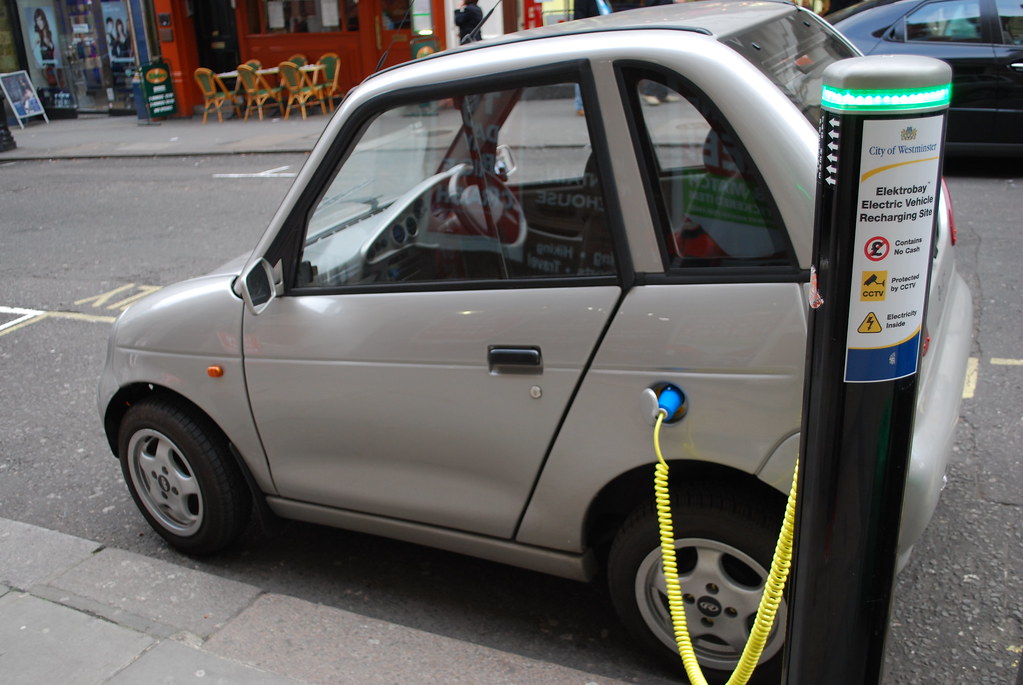
Featured image: Electric car charging — Alan Trotter (BY) via Openverse