How Do Tariffs Work? A Plain-English Explainer
8 min read
You hear the word in headlines all the time, but the mechanics stay fuzzy. So how do tariffs work, exactly, and why should you care about a tax that lands on goods crossing a border thousands of miles away? In plain English, a tariff is a tax a government charges on products imported from another country. It sounds like a problem for big companies and shipping firms, yet the effects often trickle down to the price you pay at the checkout. This explainer walks through the whole chain, step by step, without the economics-textbook jargon.
What Is a Tariff? A Simple Definition
A tariff is a tax applied to goods when they are brought into a country from abroad. It is collected by the importing nation’s customs authority at the point of entry, such as a seaport, airport, or land border crossing. Tariffs are sometimes called customs duties or import duties, and the terms broadly mean the same thing.
Tariffs usually come in one of two forms:
- Ad valorem tariffs are charged as a percentage of the product’s value. A tariff of 10 percent on a shipment worth a certain amount means the importer pays a tenth of that value in duty.
- Specific tariffs are a fixed fee per unit, such as a set charge per kilogram or per item, regardless of the price.
Some countries also use compound tariffs, which combine both methods. The key idea to hold onto is simple: a tariff makes imported goods more expensive than they would otherwise be.
How Do Tariffs Work Step by Step at the Border
To really understand how do tariffs work, it helps to follow a shipment through the system. The process generally unfolds like this:
- A product is classified. Every imported item is assigned a code under an internationally recognised classification system. That code determines which tariff rate applies.
- Its value is declared. The importer reports the value of the goods to customs, which forms the basis for an ad valorem calculation.
- The duty is calculated. Customs applies the relevant tariff rate to the declared value or quantity.
- The importer pays. Before the goods can clear customs and enter the domestic market, the importer settles the duty owed.
- The goods are released. Once payment clears, the products are free to move on to warehouses, retailers, or factories.
The money collected goes to the government’s treasury. From there it becomes general revenue, much like other taxes. The crucial point is that the tariff is paid by the party importing the goods, not by the foreign company that made them.
Who Actually Pays Tariffs: Importers, Businesses, or You?
This is where a lot of confusion creeps in. Politically, tariffs are often described as a charge on another country. Mechanically, that is not how the payment works. The importer of record, which is usually a domestic business bringing the goods in, is the entity that actually hands money to customs.
What happens next depends on the choices that business makes. There are a few possibilities:
- The importer absorbs the cost and accepts a thinner profit margin.
- The importer passes the cost on to wholesalers and retailers, who in turn may raise prices for shoppers.
- The foreign supplier lowers its price to stay competitive, effectively sharing the burden.
- Buyers switch to a cheaper domestic alternative or a supplier in a country with a lower tariff.
In practice, the burden is usually split among these parties, and the exact division varies by product and market. The takeaway for everyday consumers is that tariffs can raise the prices of imported goods, even though no shopper ever fills out a customs form.
Why Governments Impose Tariffs and the Goals Behind Them
If tariffs can push up prices, why use them at all? Governments turn to tariffs for several reasons, and understanding how do tariffs work means understanding these motives.
Protecting domestic industries
By making imports more expensive, a tariff can give locally made products a price advantage. This is meant to shield home-grown businesses and jobs from foreign competition, especially in industries a government considers strategically important.
Raising revenue
Historically, tariffs were a major source of government income before broad income and sales taxes existed. They still generate revenue today, though for many developed economies this is a smaller piece of the budget.
Responding to trade disputes
Tariffs can be used as leverage in negotiations or as retaliation when one country believes another is trading unfairly, for example by subsidising its exporters or flooding a market with cheap goods.
Supporting policy goals
Governments sometimes use tariffs to discourage reliance on a particular country, encourage local manufacturing, or pursue broader strategic aims.
How Tariffs Affect Prices, Supply Chains, and Everyday Goods
Tariffs rarely affect a single product in isolation. Modern goods are built from components sourced across many countries, so a duty on one input can ripple outward.
- Direct price effects. Imported finished goods subject to a tariff may become more expensive on the shelf.
- Knock-on effects. If a tariff hits a raw material or part, manufacturers that rely on it face higher production costs, which can raise the price of the final product, even one assembled domestically.
- Supply chain shifts. Businesses may reroute their sourcing to suppliers in countries with lower tariffs, change product designs, or build new relationships, all of which take time and money.
- Reduced choice. Some foreign products may become uneconomical to import at all, narrowing the range of options available to buyers.
Because these adjustments take time, the full impact of a tariff is not always felt immediately. Supply chains are slow to turn, and the eventual effect on prices depends on competition, demand, and how flexible businesses can be.
Tariffs vs. Quotas and Other Trade Barriers
Tariffs are just one tool in a broader category called trade barriers, which are measures that restrict the free flow of goods between countries. It helps to know how they differ.
- Quotas limit the quantity of a particular good that can be imported during a set period. Instead of taxing imports, a quota caps how many can come in at all.
- Embargoes are outright bans on trading certain goods with certain countries, usually for political or security reasons.
- Subsidies work from the opposite direction, with a government supporting its own producers so they can compete more cheaply, rather than penalising imports.
- Non-tariff barriers include rules, standards, licensing requirements, and paperwork that make importing harder without applying a direct tax.
The defining feature of a tariff is that it raises the cost of imports through a tax while still allowing the goods to enter, whereas a quota restricts volume and an embargo blocks trade entirely.
The Pros and Cons of Tariffs for an Economy
Tariffs are a genuinely contested topic among economists and policymakers, and reasonable people disagree about when they help. Here is a balanced look at the trade-offs.
Potential benefits
- They can protect emerging or strategically important domestic industries while those industries find their footing.
- They generate government revenue.
- They can serve as bargaining tools in trade negotiations.
- They may help guard against practices a country considers unfair.
Potential drawbacks
- They can raise prices for consumers and businesses that depend on imported goods or parts.
- They may invite retaliation, with trading partners imposing their own tariffs in response.
- They can reduce competition, which sometimes lessens the pressure on domestic firms to keep prices low or innovate.
- They can disrupt established supply chains and create uncertainty for businesses planning ahead.
Whether a particular tariff is a net positive depends heavily on the industry, the goal, and how trading partners respond.
Frequently Asked Questions
Do tariffs make foreign countries pay the importing country?
Not directly. The importing business pays the tariff to its own government’s customs authority. A foreign supplier might lower its prices to stay competitive, which shares the burden, but the legal payment is made by the domestic importer, not the foreign nation.
Does a tariff always raise the price I pay as a consumer?
Not always. Whether the cost reaches shoppers depends on how the importer responds. Sometimes the business absorbs the cost or the supplier discounts to compete, and sometimes the higher cost is passed along. In many cases the burden is shared, so price increases can be partial rather than dollar-for-dollar.
What is the difference between a tariff and a tax?
A tariff is a specific type of tax. The broad word tax covers many charges, including income and sales taxes, while a tariff applies specifically to goods imported across a border. So every tariff is a tax, but not every tax is a tariff.
The Bottom Line
Now that you can answer how do tariffs work, the headlines should make a lot more sense. A tariff is a tax on imported goods, collected at the border from the importing business, used by governments to protect industries, raise revenue, or apply pressure in trade disputes. The cost can stay with the importer, get passed to consumers, or be shared along the way. Tariffs are neither automatically good nor bad, but knowing how they flow through the economy helps you read the news and understand the prices you pay with a clearer eye.
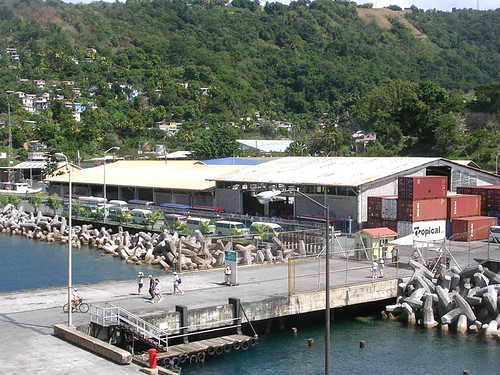
Featured image: Dominica - Cruise Ship / Container Port — roger4336 (BY-SA) via Openverse